Prefab Cabinets Without Custom Prices
The moment a wall measures 118 inches, the cabinet plan stops being a shopping list and becomes arithmetic. CasaBuilt's wall cabinets come in 3-inch steps from 9 in to 39 in, so a run that is not a multiple of three ends in a filler. The published price per inch of width ranges from $8.55 at 21 in to $19.95 at 9 in, and the difference is what a filler budget is really competing with.
Key takeaways
- Wall widths run 9 in to 39 in in 3-inch steps, with 30 in, 36 in and 42 in heights.
- The 21 in wall cabinet is the cheapest published option per inch at $8.55; the 9 in is the dearest at $19.95.
- A 24 in and a 30 in double-door wall cabinet both list at $347.76, so six inches cost nothing extra.
- Fillers and trim are not part of the cabinet price and belong in the budget as their own line.
The gap at the end of the run
Standard cabinets are sold in nominal widths, and nominal widths are multiples of three. That works beautifully until the tape measure returns a number like 118 or 122. The difference between the wall and the sum of the cabinets has to be absorbed by something, and that something is a filler strip, a trim piece or a slightly different cabinet mix.
This is the line item that disappears from most prefab quotes. The cabinet list totals cleanly, the freight is quoted, and then the installer arrives with a 2-inch gap at the window trim and no material to close it. On a single wall the cost is small. Across a kitchen with three separate runs, it happens three times.
The fix is to plan in inches from the start. Write the measured run, subtract the appliances and the trim, then fit published widths into what remains. Whatever is left over is the filler, and it should be chosen before the order is placed rather than improvised on site.
Standard widths, priced by the inch
Dividing the published sale price by the nominal width gives a comparable number across the range, and it exposes the shape of the pricing. Every figure below is a 30 in high wall cabinet from the same line.
| Wall cabinet | Sale price | Price per inch | Gross volume | Doors |
|---|---|---|---|---|
| 9 in x 30 in | $179.54 | $19.95 | 1.88 cu ft | Single |
| 21 in x 30 in | $179.54 | $8.55 | 4.38 cu ft | Single |
| 24 in x 30 in | $347.76 | $14.49 | 5.00 cu ft | Double |
| 30 in x 30 in | $347.76 | $11.59 | 6.25 cu ft | Double |
| 36 in x 30 in | $347.76 | $9.66 | 7.50 cu ft | Double |
| 39 in x 30 in | $347.76 | $8.92 | 8.13 cu ft | Double |
Two pricing structures sit in that table. Single-door cabinets carry one price, $179.54, whether the door is 9 in or 21 in wide. Double-door cabinets carry one price, $347.76, from 24 in to 39 in. The hinge count and the door count set the price, not the panel area, which is why the price per inch falls so sharply as width increases.
That has a direct consequence for a filler budget. A narrow cabinet is not a cheap way to close a gap. At $179.54 for 9 inches, the small box costs more per inch than any other width in the range, and the gap it fills could often be handled by a filler strip for far less. The cabinet is only worth it when the extra door and the extra storage are wanted.
Where the price per inch misleads
Cheap per inch is not the same as cheap. The 21 in single-door cabinet is the best value by that measure at $8.55, but it delivers 4.38 cubic feet against the 39 in box's 8.13 cubic feet. A buyer filling a long blank wall with 21 in cabinets pays less per inch and buys more doors, hinges and handles, which is a different total.
Run the comparison on a real number. Five 21 in cabinets reach 105 inches and cost five times $179.54, or $897.70. Four 30 in cabinets reach 120 inches and cost four times $347.76, or $1,391.04. The 30 in route buys 15 more inches and 3.13 more cubic feet for $493.34. Neither is wrong; they answer different questions about how much wall has to be covered.
The published prefab cabinets are also available in 36 in and 42 in heights, which changes the arithmetic again. A 36 in high single-door wall is $197.06, and a 42 in high single-door wall is $222.57. Taller cabinets cost more per unit but add vertical storage without adding width, which is often the cheapest way to increase capacity in a small kitchen.
Height also affects where the filler goes: a 42 in wall cabinet leaves less wall above the door for crown or a light rail than a 30 in cabinet, so measure that trim before locking the heights.
Planning a run that ends in a filler
Start with the finished wall length to the nearest eighth of an inch. Subtract the space reserved for the range hood, the window trim and any end panel. The remainder is the cabinet zone. Fit published widths into that zone, preferring the widest boxes that keep the doors where they are wanted, and note the leftover.
Take a 122 in wall. Four 30 in cabinets total 120 in and leave a 2 in filler at the end, which is a normal, paintable strip. The same 122 in wall could take 39 in, 39 in, 21 in and 21 in for 120 in, leaving the same 2 in filler but costing $1,054.60 instead of $1,391.04. Same width, same gap, $336.44 less, and two fewer doors to align.
That is the practical version of shopping without custom prices. The catalog does not bend, so the plan bends around it. Two inches of filler beside a window reads as trim. A two-inch gap with no filler reads as a mistake.
Measure twice before ordering, and measure the same way the installer will. The published measurement guide covers the checks that matter, including the high and low points of a wall that is not plumb. A run measured at the counter can lose half an inch at the ceiling, and half an inch is enough to change the cabinet mix.
Order the filler with the cabinets, not after them. A second small order carries its own freight and its own wait, and a kitchen cannot be finished around a missing strip.
Worked example
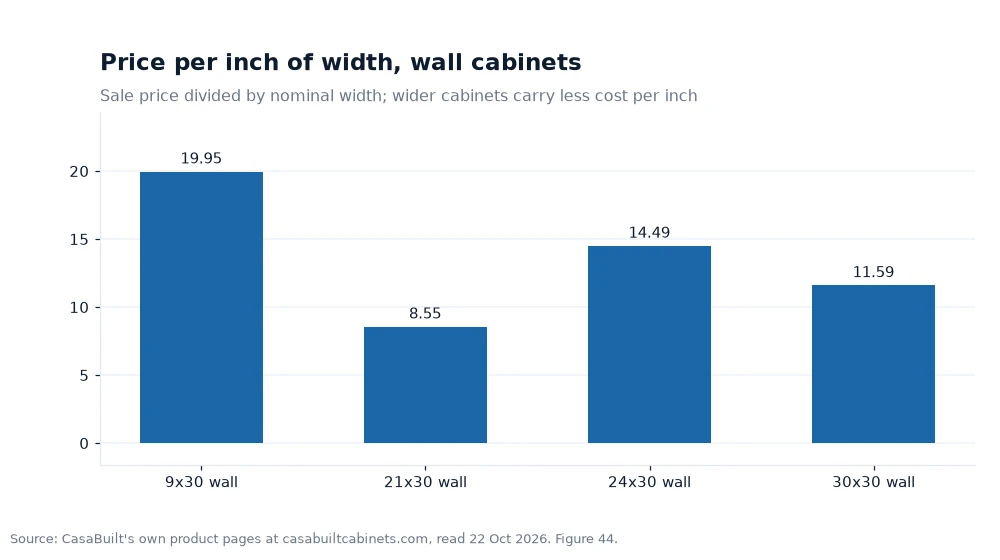
The chart gives four 30 in high wall cabinets at their published price per inch: the 9 in at $19.95, the 21 in at $8.55, the 24 in at $14.49 and the 30 in at $11.59. Start with the extremes. The 9 in cabinet costs $19.95 minus $8.55, or $11.40 more per inch than the 21 in, and $19.95 divided by $8.55 is 2.33, so it is 133% dearer per inch.
Now the middle pair. The 24 in cabinet costs $14.49 minus $11.59, or $2.90 more per inch than the 30 in, which is 20% because $2.90 divided by $14.49 is 0.20. Both list at $347.76, so the 30 in version returns six extra inches and 1.25 extra cubic feet for no extra money. On a 120 in run, four 30 in cabinets cost $1,391.04, which is $11.59 per inch. The same 120 in built as 39, 39, 21 and 21 costs $1,054.60, which is $8.79 per inch, and leaves a 2 in filler on a 122 in wall.
Frequently asked questions
What size filler strip will I need?
It depends on the measured run. Wall widths come in 3-inch steps from 9 in to 39 in, so a wall that is not a multiple of three leaves a remainder. Measure to the nearest eighth of an inch, subtract the appliance and trim allowances, then note the leftover; a 122 in wall fitted with 120 in of cabinets needs a 2 in filler.
Can a cabinet be cut down to fit instead of using a filler?
Cutting a finished cabinet changes its structure and its door fit, so the safer route is to choose a different mix of published widths and close the remainder with a filler or trim. CasaBuilt publishes widths in 3-inch steps for exactly this reason, and the measurement guide covers the checks before ordering.
Are fillers included in the cabinet price?
No. The published sale prices cover the cabinets themselves, such as $179.54 for a 9 in wall and $347.76 for a 24 in to 39 in double-door wall. Filler strips and trim are separate items, so they should be listed and priced in the quote rather than discovered during installation.
Measure, fit, then order
Draw the wall to scale and write the published width under every box, then write the leftover at the end. If the leftover is under an inch, adjust the mix rather than forcing a sliver of filler. If it is two or three inches, a painted strip is cheaper than a narrow cabinet and just as clean. The cabinet order should end with a number that matches the wall, not a number that matches the catalog.
Figures quoted here come from the manufacturer's own website, read 22 Oct 2026[1].