Common Challenges in Choosing a China sourcing partner
A sourcing partner should fill a defined capability gap and produce evidence that supports buyer decisions. Compare the actual work, incentives, communication process, and decision boundaries before the relationship becomes part of an order.
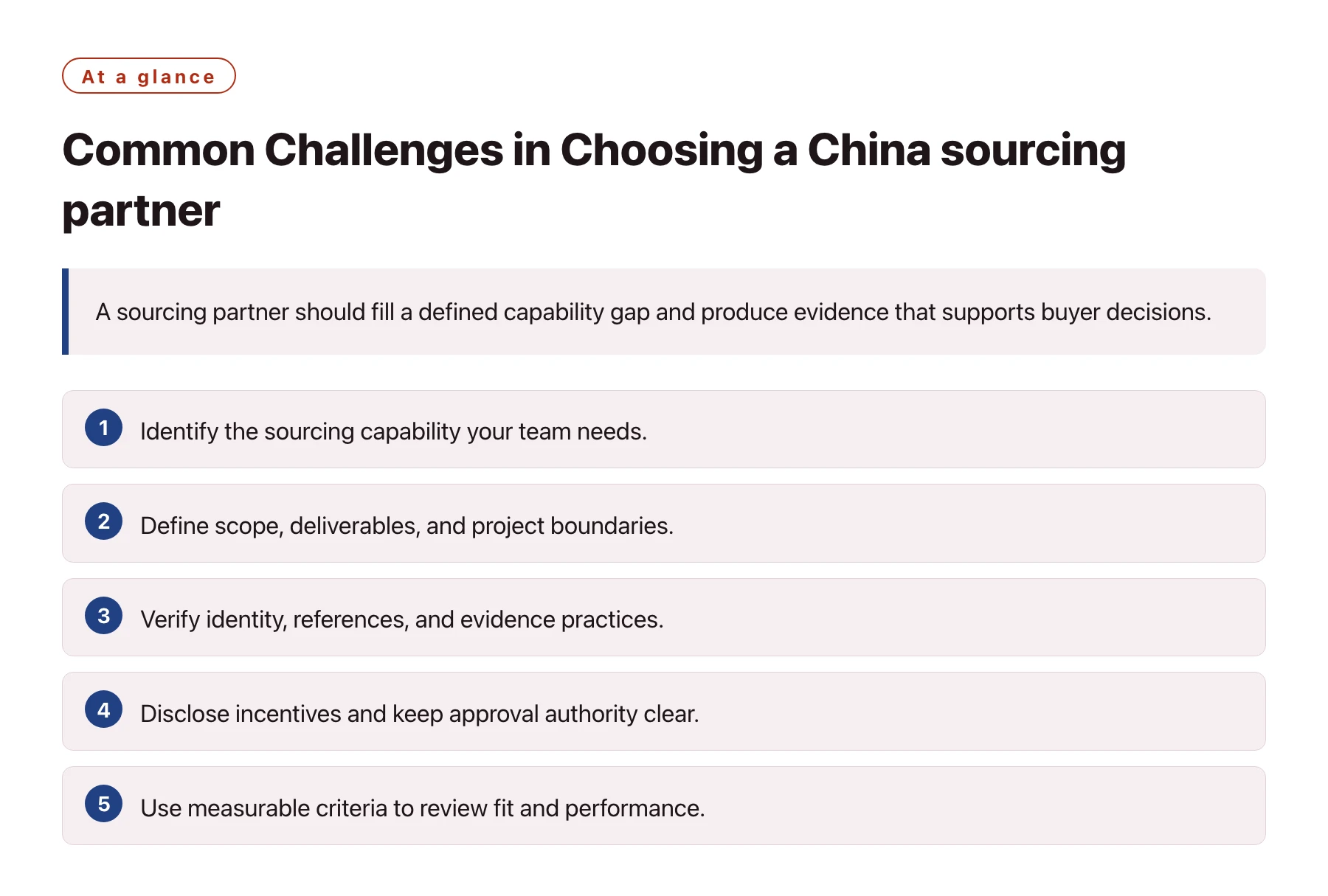
Key takeaways
- Identify the sourcing capability your team needs.
- Define scope, deliverables, and project boundaries.
- Verify identity, references, and evidence practices.
- Disclose incentives and keep approval authority clear.
- Use measurable criteria to review fit and performance.
Partner selection is a governance decision as well as a service purchase. Clear deliverables and authority limits make the relationship easier to manage.
1. Start with the capability gap
A sourcing partner is most valuable when it fills a clear capability gap: supplier discovery, local communication, quote comparison, sample coordination, factory follow-up, or inspection planning. List what your team can do internally and where time, language, technical context, or local access create friction. The best-fit partner depends on that gap.
Describe a real use case and a deliverable you need. A shortlist with evidence is different from a factory introduction; a dated inspection report is different from arranging a visit. When the expected work is explicit, proposals can be compared on their actual contribution instead of a general promise to help.
2. Define the project and its limits
Prepare product specifications, destination market, order profile, schedule, budget assumptions, and current supplier knowledge. Identify regulated, safety-sensitive, confidential, or technically uncertain areas. State which decisions require a qualified engineer, quality professional, customs specialist, or regulatory owner.
Separate the initial assignment from optional future phases. For example, supplier search may precede sample coordination and production support, each with its own deliverable and fee. This prevents the first engagement from becoming an undefined commitment to handle every activity through delivery.
3. Compare service models and coverage
Ask whether the candidate is an independent sourcing service, trading company, manufacturer, buying office, or a combination. Each model can provide different access, incentives, service scope, and accountability. Ask how its role changes when one supplier is selected and whether the buyer contracts directly with the factory.
Request a stage-by-stage description of discovery, screening, quotation, samples, quality checks, production updates, and shipping handoff. Record which activities are performed by the partner, a subcontractor, or the buyer. Clarify whether service is limited to selected categories, regions, order sizes, or communication windows.
4. Check identity, references, and evidence
The U.S. Department of Commerce recommends due diligence when evaluating foreign business partners. Verify the contracting entity, authorized contacts, address, payment beneficiary, references, and key capability claims using proportionate independent checks. Record sources and dates; do not treat a website or directory entry as proof of performance. [1]
Ask for redacted examples of supplier comparisons, visit reports, issue logs, and status updates. Look for clear criteria, dated evidence, limitations, and owners. With permission, contact references whose products, scope, or order complexity resembles yours, and ask how exceptions and delays were handled.
5. Examine incentives and supplier relationships
Ask how the partner is paid: fixed fee, hourly rate, commission, supplier payment, referral benefit, or a combination. Clarify when compensation is earned, how it is calculated, and whether the partner receives different benefits from different factories. Disclosure lets the buyer understand incentives; it does not automatically prove or remove a conflict.
Agree what the partner may recommend, negotiate, or approve. Require written disclosure of relevant supplier relationships and buyer approval for any supplier appointment or commitment outside delegated authority. If a provider receives supplier compensation, decide whether direct quotations or independent comparisons are needed.
6. Test communication and escalation
Identify the person who will run the work, the backup contact, working time zone, languages, update cadence, and response expectations. Ask how urgent quality, schedule, or payment issues are escalated and what record confirms a decision. A named account owner is more useful than an organizational chart alone.
Discuss a realistic scenario: a supplier changes a material, a sample fails, or a production milestone slips. Ask who informs the buyer, what evidence is gathered, what choices are presented, and who can authorize added cost or shipment. This reveals whether the partner has a usable exception process.
7. Compare cost and commercial risk
Normalize fee models against the same scope and expected workload. Include minimum charges, travel, samples, translation, third-party testing, rush work, banking fees, taxes, and termination costs. Ask for separate supplier pricing and sourcing-service fees where possible, then compare total expected cost with the internal effort the service replaces.
Review payment milestones, refund conditions, confidentiality, ownership of reports, record access, liability boundaries, and termination handoff. A provider should not be expected to guarantee a supplier’s future performance unless the contract clearly defines that responsibility. Identify open terms before work begins.
8. Keep decision authority clear
Assign buyer owners for supplier selection, specification approval, price, sample acceptance, production release, deviations, and final shipment. A partner may recommend or coordinate, but the buyer needs to know who has authority to commit funds or change requirements. State any delegated negotiation limit in writing.
Use a decision log for approvals and changes. Keep commercial decisions separate from technical and regulatory review. When the sourcing partner summarizes a supplier claim, record whether it was independently checked, what evidence supports it, and what remains uncertain.
9. Use a bounded evaluation when fit is uncertain
A pilot assignment can test reporting, evidence quality, responsiveness, and handoffs. Choose a task with defined scope, limited exposure, and measurable completion criteria. Examples include building a shortlist for one item or comparing quotations against an approved specification.
At the end, review actual deliverables and unresolved gaps against the agreement. Decide what should change before a larger assignment. A pilot is optional when capability and process fit are already established, and it should not bypass controls for high-risk or regulated products.
10. Choose the partner you can govern
Use a scorecard covering fit to scope, relevant experience, evidence quality, incentive transparency, communication, data handling, fee clarity, and escalation capability. Keep minimum requirements separate from weighted preferences and write down the reason for selection. Confirm that the contracting entity and payment details match the reviewed proposal.
Teams evaluating js-sourcing.com can compare the provider’s current scope and working process against a written project brief. Confirm deliverables, fees, supplier relationships, decision limits, and exit handoff directly, then preserve buyer authority over purchase and product approvals.
Sources
Frequently asked questions
How do I choose a China sourcing partner?
Define the capability gap, compare exact deliverables, verify the contracting party and evidence, disclose incentives, and test communication.
Should a sourcing partner receive supplier commissions?
It depends on the arrangement, but any supplier compensation and its effect on recommendations should be disclosed and agreed in writing.
What is a useful first task for a new partner?
Choose a bounded assignment with a clear output, limited exposure, and criteria for reviewing evidence and responsiveness.
Who should make the final supplier choice?
The buyer’s authorized owner should approve supplier, price, specification, and production decisions unless authority is expressly delegated.